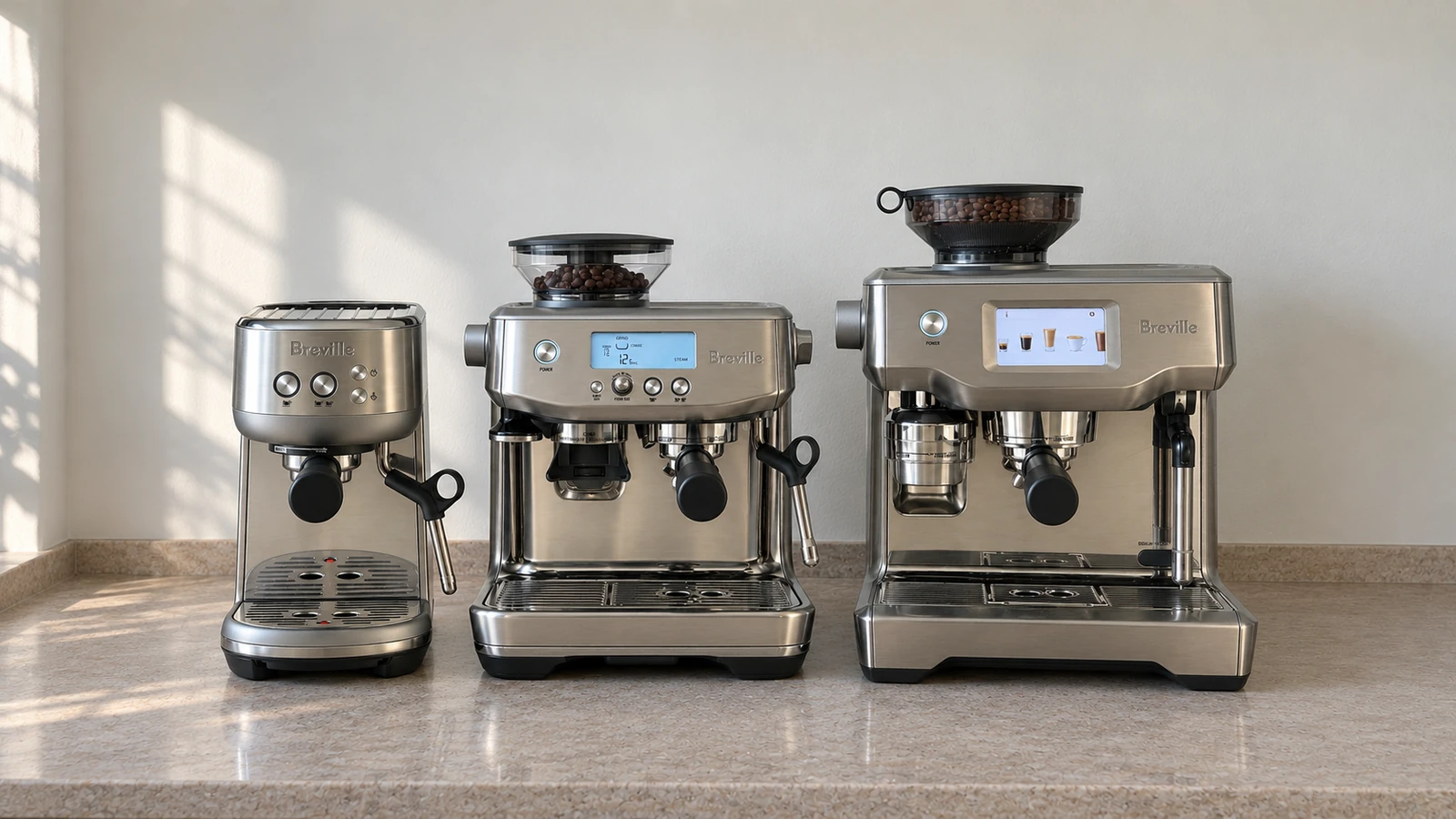
Breville espresso machines range from around $300 to well over $2,000, so it is worth knowing where your money goes.
I have tested several Brevilles (sold as Sage in the UK) and spent a lot of time with Breville's customer support team. I ranked them on espresso, milk steaming, ease of use, durability and value.
My picks:
- Best overall: Breville Dual Boiler
- Best budget: Breville Bambino
- Best for beginners: Breville Bambino Plus
- Easiest to use: Breville Barista Touch Impress
- Best with a built-in grinder: Breville Barista Pro
I also explain why I would skip the popular Barista Express and Infuser.
Picks at a Glance
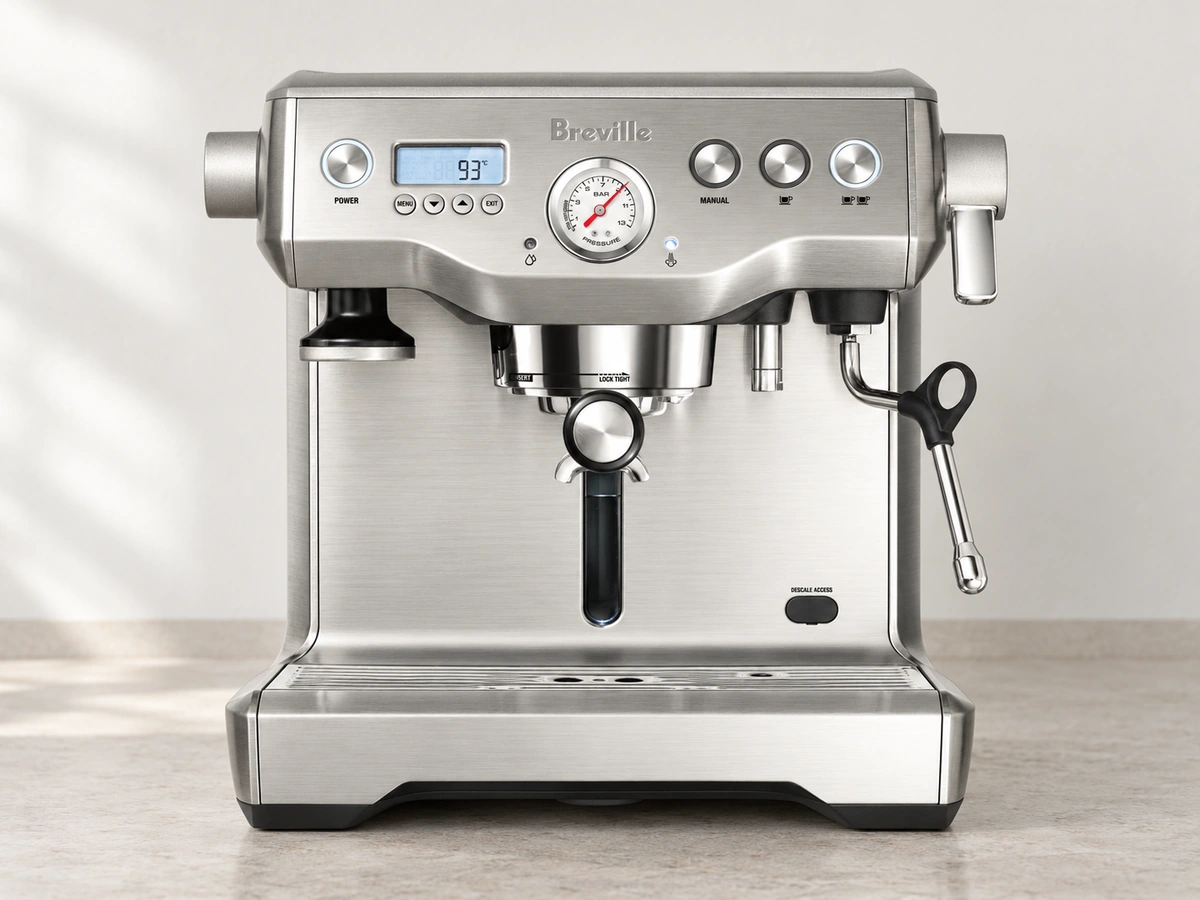
Breville Dual Boiler: Best Overall
- The best espresso of any Breville here
- The most durable Breville
- Easier for a technician to service
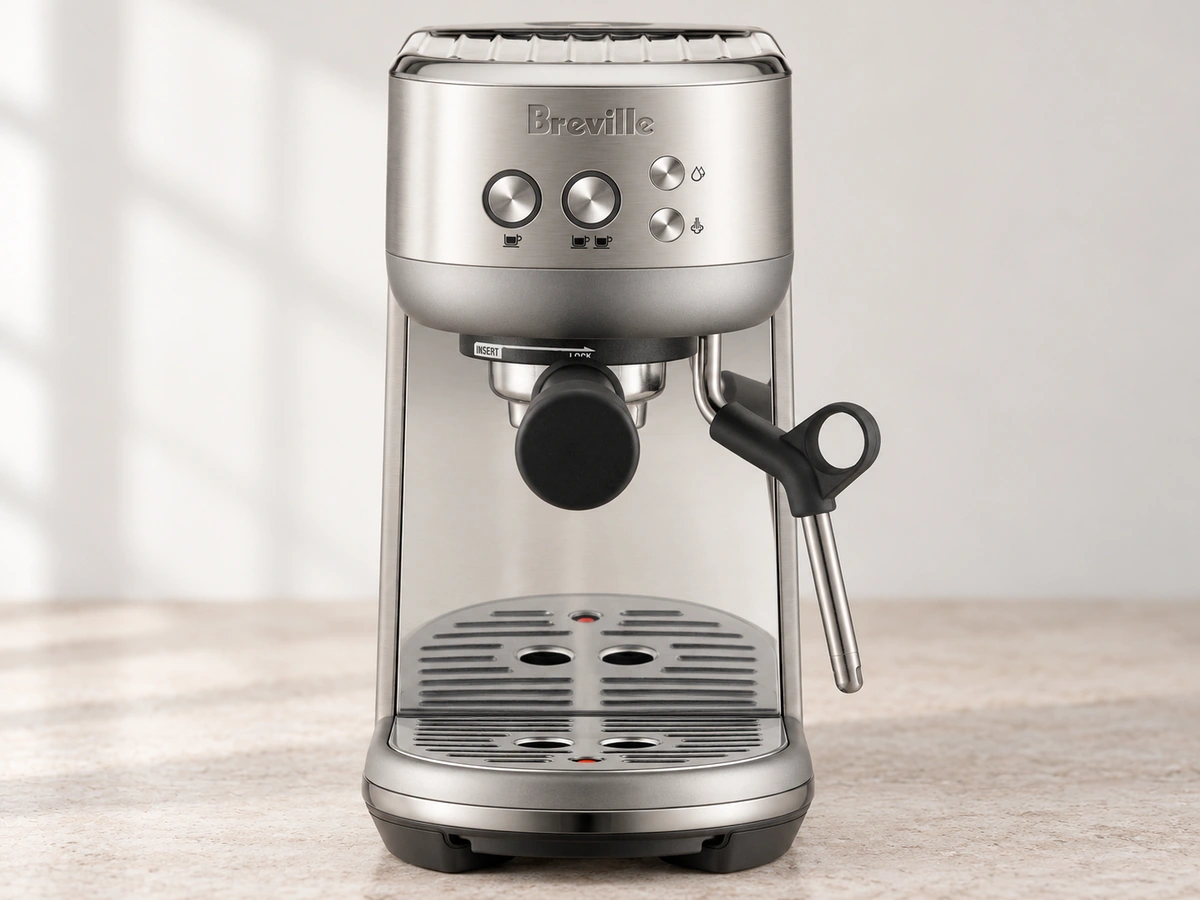
Breville Bambino: Best Budget
- Fast heat-up
- Pairs with a decent grinder for around $500 total
- Excellent price-to-performance
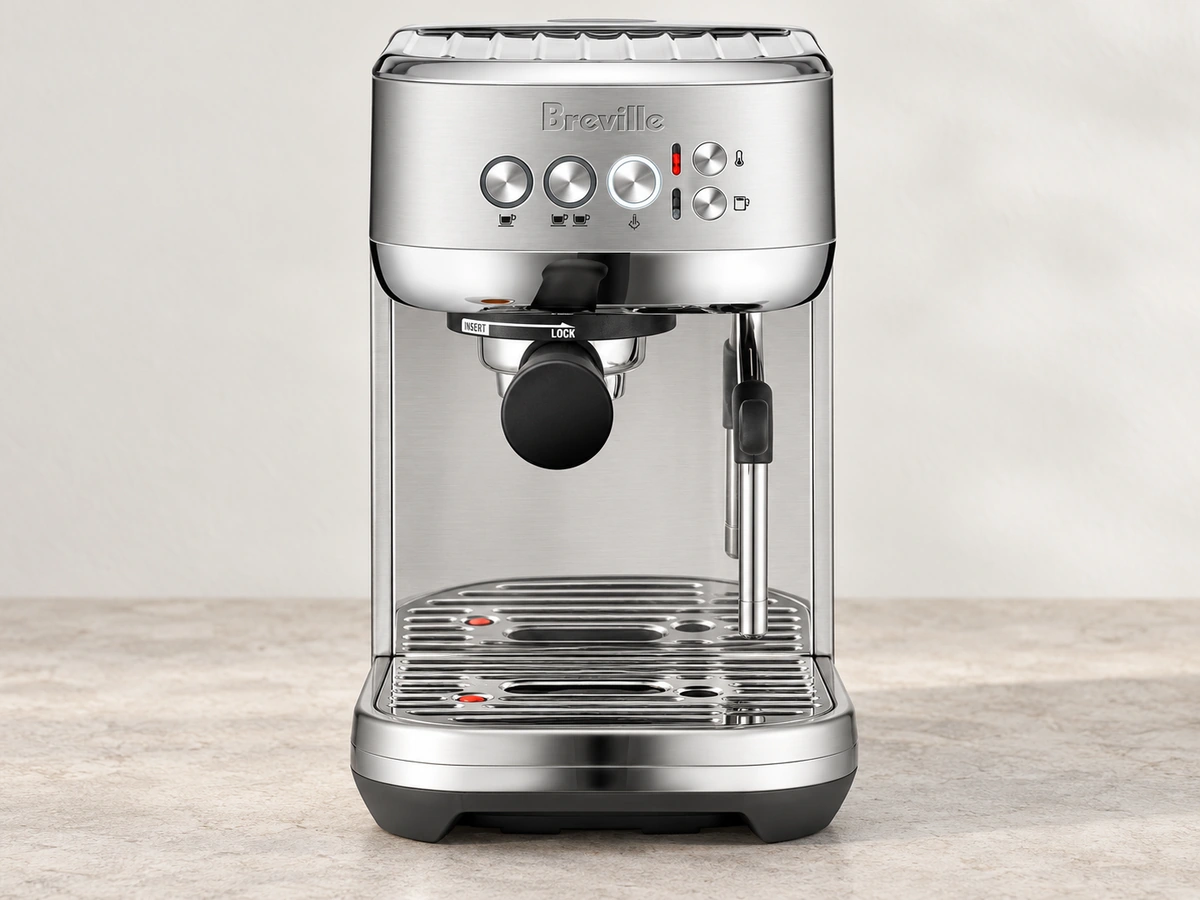
Breville Bambino Plus: Best for Beginners
- Automatic steam wand
- Compact
- Pairs with a good grinder for well under $1,000
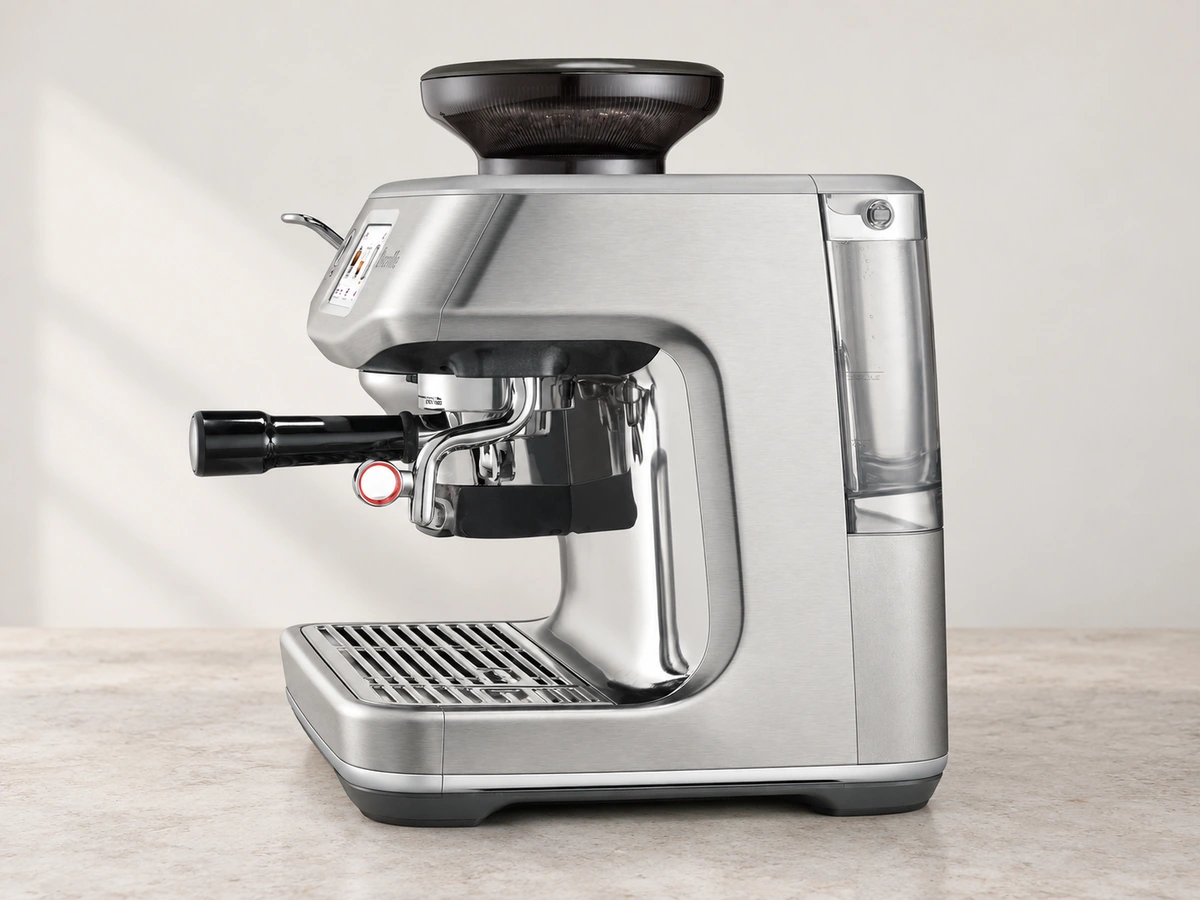
Breville Barista Touch Impress: Easiest to Use
- Guides you through dosing and tamping
- Touchscreen
- Automatic steam wand
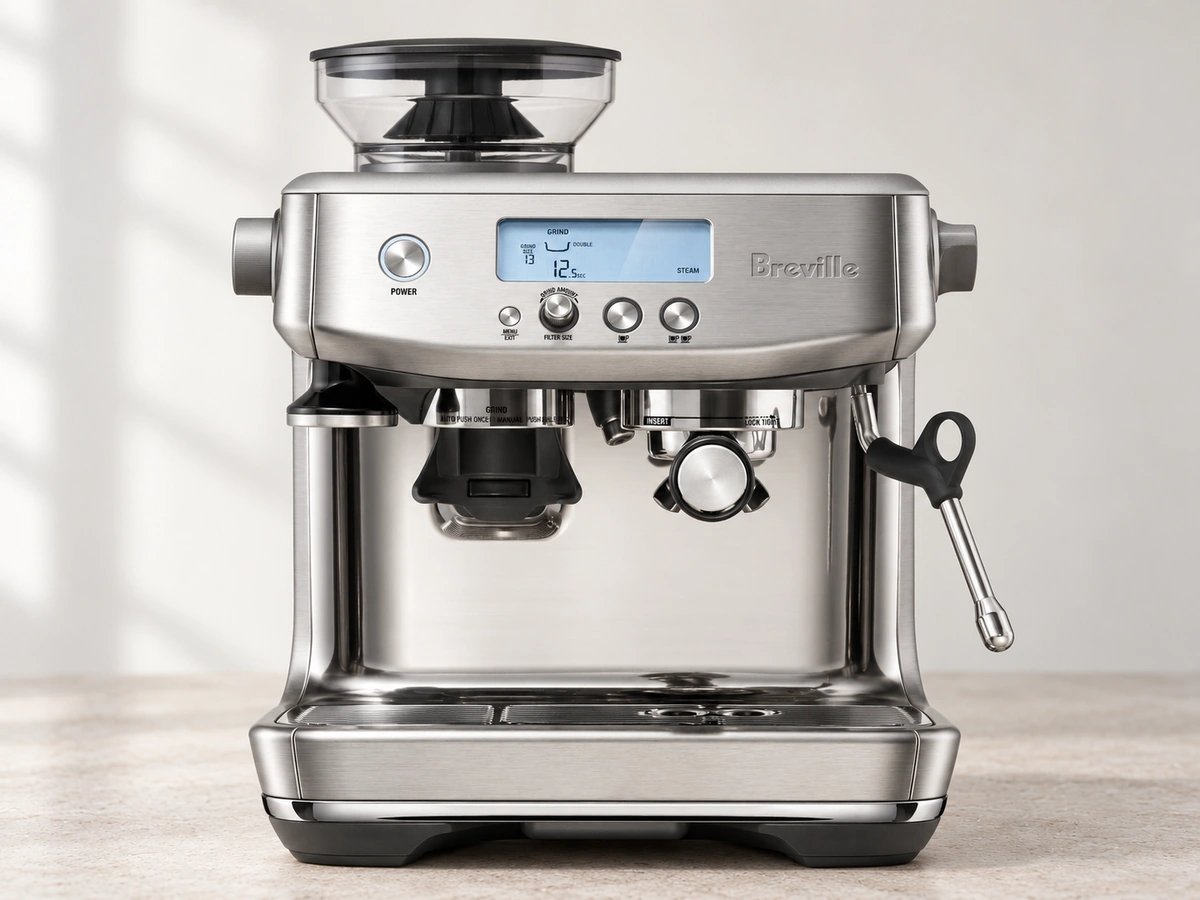
Breville Barista Pro: Best With a Built-In Grinder
- 30-step grinder
- Digital display
- Built-in shot timer for easy dialing in
How Breville Machines Differ
Five things separate Breville models:
- Price
- Automation: some have assisted tamping and automatic milk steaming
- Heating system: thermocoil, ThermoJet or dual boiler. Every Breville has a PID.
- Grinder: some have a built-in conical burr grinder
- Controls: buttons only, buttons with a pressure gauge, a digital display or a touchscreen
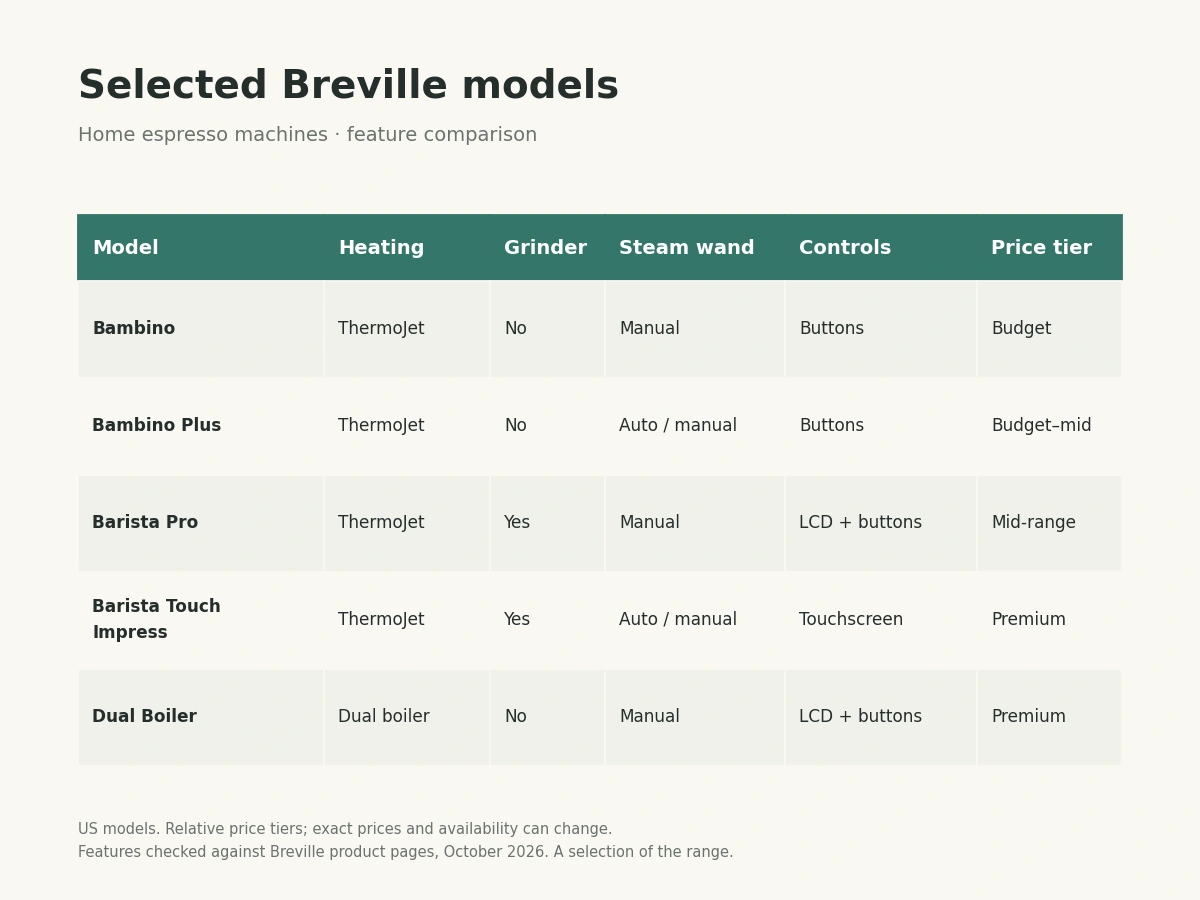
Price
You pay more for automation, a built-in grinder, nicer controls and a better heating system.
I think a better heating system is the most worthwhile upgrade, because temperature stability directly affects taste and consistency. Assisted tamping and automatic milk steaming are also worth it if you do not want a learning curve.
A built-in grinder is usually not worth paying extra for (more on that below), and fancier controls are a luxury rather than a must.
Heating System
Dual boiler is the best, ThermoJet is second, and thermocoil is the weakest.
- Dual boiler: separate heated boilers for brewing and steaming
- ThermoJet: Breville's fast-heating system that heats water on demand as it flows through
- Thermocoil: an older on-demand system with a heated metal block around the water line
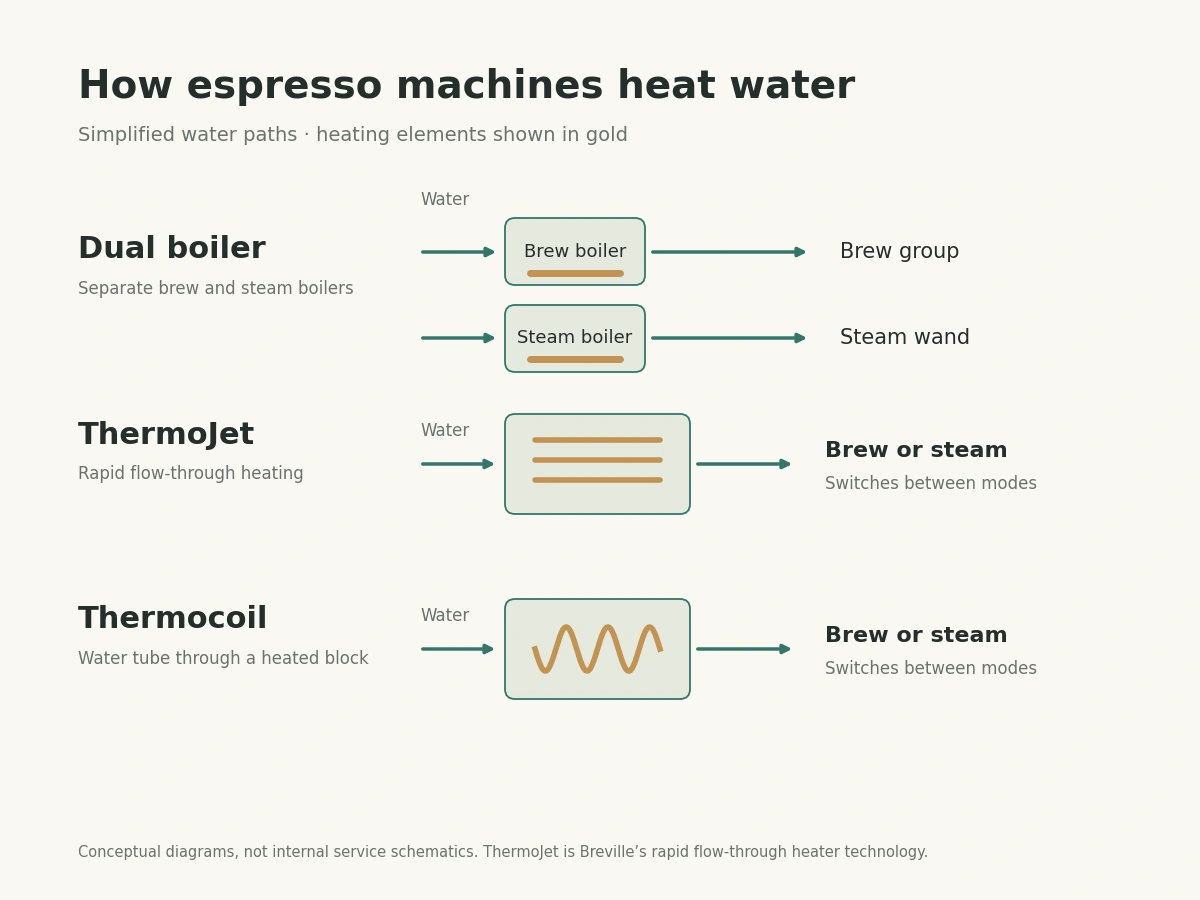
| Thermocoil | ThermoJet | Dual boiler | |
|---|---|---|---|
| Temperature stability | Lowest | Middle | Highest |
| Heat-up time | ~40 s | ~3 s | Several minutes |
| Brew and steam at the same time | No | No | Yes |
| Switch from brewing to steaming | Slower | Under 10 s | Instant |
| Needs a blank shot to preheat | Yes | Often | No |
| Long-term durability | Lower | Lower | Higher |
| Cost | Lower | Lower | Higher |
If you can afford it, get a dual boiler. Its biggest advantage is durability. On-demand heaters tend to wear out after about four or five years and are not easy to replace, while a dual boiler machine can last much longer and is easier to repair.
If not, choose ThermoJet over thermocoil. Thermocoil machines struggle with back-to-back shots and with switching from steaming back to brewing.
| Machine | Heating |
|---|---|
| Dual Boiler | Dual boiler |
| Bambino | ThermoJet |
| Bambino Plus | ThermoJet |
| Barista Touch Impress | ThermoJet |
| Barista Pro | ThermoJet |
Automation
Breville's assisted tamping and automatic steam wand both work well, and I recommend them if you want café drinks with little effort.
- Automatic steam wand: choose a temperature and texture, put the wand in the jug, and the machine steams the milk for you. Every Breville auto wand can also be used manually.
- Assisted tamping: after grinding, you pull a lever and the machine tamps for you.
What I like most is that neither forces automation on you. You can always do it yourself.
Most Brevilles also stop shots automatically at a set volume, which is a big reason I think Breville makes the best espresso machines for beginners.
| Machine | Automatic steam wand | Assisted tamping |
|---|---|---|
| Dual Boiler | No | No |
| Bambino | No | No |
| Bambino Plus | Yes | No |
| Barista Touch Impress | Yes | Yes |
| Barista Pro | No | No |
Built-In Grinder or Not?
Brevilles with a built-in grinder are easier, but they have a lower ceiling for espresso quality than a machine with a good separate grinder.
The first Breville I owned was the Barista Pro. I loved the idea of an all-in-one. But after a year, I realized I needed a better grinder to improve my espresso, which was frustrating since I had paid extra for the built-in one.
In hindsight, I should have bought a machine and a separate grinder so I could upgrade later. A built-in grinder still makes sense if you are sure you will not get deep into espresso, or if it is a gift. See our pick of the best espresso grinders.
| Machine | Built-in grinder |
|---|---|
| Dual Boiler | No |
| Bambino | No |
| Bambino Plus | No |
| Barista Touch Impress | Yes |
| Barista Pro | Yes |
Controls
Nicer controls mainly help while dialing in. I would not pay much extra for them.
From cheapest to priciest: buttons only, buttons with a pressure gauge, a digital display, and a touchscreen. The displays are well designed, but they mostly help with dialing in and changing settings, which you do not do often.
| Machine | Controls |
|---|---|
| Dual Boiler | Display and buttons |
| Bambino | Buttons only |
| Bambino Plus | Buttons only |
| Barista Touch Impress | Touchscreen |
| Barista Pro | Display and buttons |
What All Brevilles Share
- Automatic shot volumes on most models, which makes them easier than many other semi-automatics
- A PID for precise brewing temperature, better than the Gaggia Classic Pro or Rancilio Silvia in stock form
- Hot water for Americanos, either from the steam wand (Bambino range) or a dedicated spout
- Good customer support. A rep once spent 40 minutes on the phone with me over a "problem" with my Barista Pro that turned out to be me backflushing it wrong.
- Accessories: single and double baskets, a stainless milk jug, a dose-trimming tool on most grinder models, and cleaning supplies
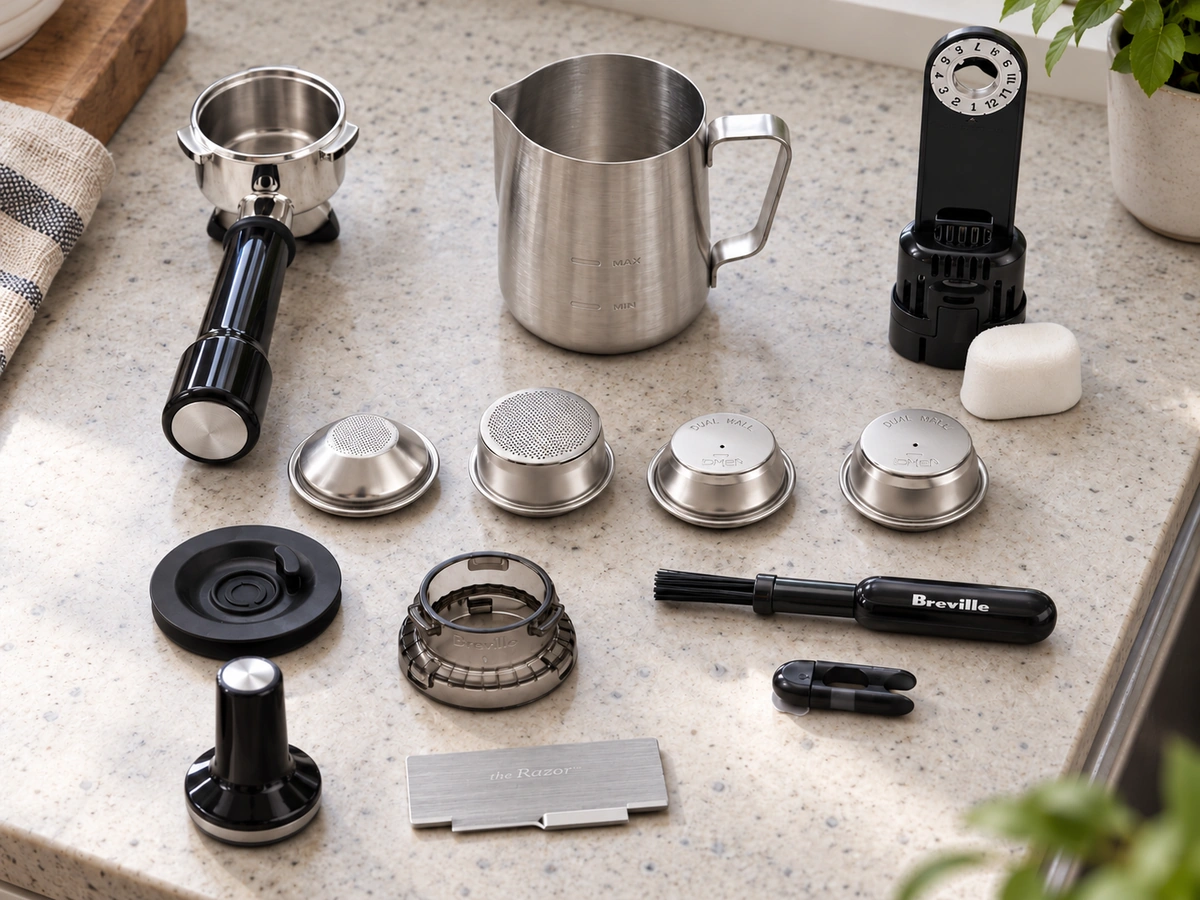
Best Overall: Breville Dual Boiler
Breville Dual Boiler
Best overall
Unmatched durability and brewing performance among Brevilles.
| Specification | Breville Dual Boiler |
|---|---|
| Heating | Dual boiler |
| Steam wand | Manual |
| Controls | Display and buttons |
| Built-in grinder | No |
| Price point | Premium |
It is sometimes sold bundled with the Breville Smart Grinder Pro for little or no extra. That is a nice bonus, but to get the most from the Dual Boiler, I would still pair it with a better grinder.
Espresso
The best espresso of any Breville, thanks to its temperature stability. With heated boilers, the whole brewing path stays at temperature, so there is no temperature drop as you brew. Only the Dual Boiler and the Oracle range offer this level of stability.
Espresso: 10/10
Milk
It steams faster and creamier than any other Breville here. Faster steaming adds less water to the milk, so the texture is thicker and creamier, closer to a good café. It has no automatic steaming, though.
Milk: 10/10
Ease of Use
No automation, and a longer heat-up time than other Brevilles. Tamping and steaming are all on you. It rewards the effort with better espresso.
Ease of use: 6/10
Build Quality
By far the most durable Breville. Brevilles have a reputation for not lasting as long as Gaggia or Rancilio machines, largely because on-demand heaters rarely last much beyond five years. The Dual Boiler's boilers are built to last, and it is much easier for a technician to repair.
Build quality: 10/10
Value
One of the most affordable dual boiler machines available. Compared with other dual boilers, rather than with cheaper Brevilles, it is excellent value.
Value: 9/10
What I like: potentially buy-it-for-life, precise temperature control, creamier milk. What I don't: you will spend well over $2,000 once you add a top grinder.
Best Budget: Breville Bambino
Breville Bambino
Best budget
The best espresso machine to pair with a decent grinder for around $500.
| Specification | Breville Bambino |
|---|---|
| Heating | ThermoJet |
| Steam wand | Manual |
| Controls | Buttons only |
| Built-in grinder | No |
| Price point | Budget |
Espresso
Good espresso, especially with non-pressurized baskets.
It has a high ceiling. In one well-known video, a barista made better espresso on a Bambino than a non-barista did on a $30,000 commercial machine.
Depending on where you buy it, it may only come with pressurized (dual-wall) baskets. Those are forgiving with pre-ground coffee, but for fresh ground coffee, pick up a set of 54 mm non-pressurized baskets. They are inexpensive.
It brews at a little under 9 bar, which is forgiving for beginners but makes very light roasts harder to extract well.
Espresso: 7/10
Milk
Nice milk texture, though it steams slowly. That actually makes it a good machine to learn on. The milk is a bit wetter than from the Dual Boiler, but fine enough for latte art.
Milk: 8/10
Ease of Use
One of the harder Brevilles to use. It has no pressure gauge or shot timer, so you need to weigh and time shots yourself while dialing in. There is no help with tamping or milk either.
Ease of use: 5/10
Build Quality
Expect around four to five years of regular use. Its simple design means fewer things can break. The ThermoJet heater is the most likely part to fail eventually.
Build quality: 6/10
Value
One of the best espresso machines under $350. It makes better espresso and milk than the De'Longhi Dedica and is far more beginner-friendly than the Gaggia Classic Pro.
Value: 10/10
What I like: outstanding value, very compact, ready in about three seconds. What I don't: no shot feedback for dialing in, struggles with very light roasts.
Read my Breville Bambino review.
Best for Beginners: Breville Bambino Plus
Breville Bambino Plus
Best for beginners
Automatic steam wand for hands-free milk.
| Specification | Breville Bambino Plus |
|---|---|
| Heating | ThermoJet |
| Steam wand | Automatic (can be used manually) |
| Controls | Buttons only |
| Built-in grinder | No |
| Price point | Budget to mid |
Espresso
The same espresso system as the Bambino. Great with medium and dark roasts, less so with very light ones. Check which baskets are included, because you may need to buy non-pressurized baskets for fresh ground coffee.
Espresso: 7/10
Milk
Decent in automatic mode, good in manual mode. In auto mode, it steams to one of three temperatures and three textures, hands-free. Latte art is tough that way, but it is very good for so little effort. In manual mode, the slow steaming gives beginners time to get the texture right.
Milk: 8/10
Ease of Use
The easiest entry-level espresso machine, thanks to its automatic steam wand. I love that you can also steam manually as you improve. Dialing in is a bit tricky without shot feedback, but once that is done, it is a breeze.
Ease of use: 9/10
Build Quality
Expect around four to five years. Like many Brevilles, it trades some long-term durability for features. It probably will not last as long as a Gaggia Classic Pro or Rancilio Silvia.
Build quality: 6/10
Value
Great value if you will use the automatic steam wand. No other machine near its price steams milk automatically like this. If you will not use it, the Bambino is better value. See Bambino vs Bambino Plus.
Value: 7/10
What I like: hands-free milk, pairs with a good grinder for well under $1,000. What I don't: worse value than the Bambino if you will not use the auto wand.
Read my Bambino Plus review and Bambino Plus vs Barista Express.
Easiest to Use: Breville Barista Touch Impress
Breville Barista Touch Impress
Easiest to use
Guided dosing, assisted tamping and automatic milk, so you can pull a good shot with no learning curve.
| Specification | Breville Barista Touch Impress |
|---|---|
| Heating | ThermoJet |
| Steam wand | Automatic (can be used manually) |
| Controls | Touchscreen |
| Built-in grinder | Yes, with assisted tamping |
| Price point | Premium |
Espresso
Capped by its grinder. It shares its brewing system with the Bambino range and Barista Pro, but its built-in grinder is closer to entry level for espresso. Grind quality matters more than almost anything for espresso, so a Bambino with a good mid-priced grinder can make better shots.
Espresso: 7/10
Milk
Excellent. Its four-hole wand steams quickly for creamy milk, and in auto mode you can set temperature and texture precisely, a big step up from the Bambino Plus.
Milk: 10/10
Ease of Use
No skill required. It guides dosing, tamps for you and steams automatically. You just move the portafilter from the grinder to the group head and pick a drink on the screen. It is one of the easiest semi-automatics you can buy; only the Oracle range is as easy, for much more money.
Ease of use: 10/10
Build Quality
Well built, but its ThermoJet heater limits its lifespan to around five years or so. The touchscreen is responsive without being jumpy.
Build quality: 8/10
Value
A bit of a bargain for the automation. It gives you near super-automatic convenience with better espresso than most super-automatics, for a similar price.
Value: 8/10
What I like: easy drinks with no experience, excellent milk control, great touchscreen. What I don't: the grinder limits espresso quality.
Compare it with similar machines in Barista Pro vs Barista Touch, Barista Express vs Barista Touch and Barista Touch vs Oracle Touch.
Best With a Built-In Grinder: Breville Barista Pro
Breville Barista Pro
Best with a built-in grinder
A display and shot timer make dialing in relatively easy.
| Specification | Breville Barista Pro |
|---|---|
| Heating | ThermoJet |
| Steam wand | Manual |
| Controls | Display and buttons |
| Built-in grinder | Yes, 30 settings |
| Price point | Mid-range |
Espresso
Good, but capped by its grinder. The brewing system is excellent. But the grinder's steps are fairly large, which limits how precisely you can dial in. When I paired my Barista Pro with a much better grinder (a Baratza Sette 270Wi), my control and my espresso improved noticeably.
Espresso: 7/10
Milk
Its four-hole wand steams faster than the Bambino's, giving creamier milk. Not quite Dual Boiler level, but noticeably better than the Bambino range.
Milk: 9/10
Ease of Use
The built-in grinder and shot timer make dialing in easy. Less moving coffee around means less mess, and the display shows grind setting, shot time and more.
Ease of use: 8/10
Build Quality
Expect around five years, limited by the heater. It feels like a clear step up from De'Longhi's built-in-grinder machines. See Breville Barista Pro vs De'Longhi La Specialista.
Build quality: 7/10
Value
Not amazing value. It is essentially a Bambino and a Smart Grinder Pro in one box, and it costs more than buying those two separately.
Value: 5/10
What I like: great four-hole steam wand, no separate grinder needed. What I don't: you cannot upgrade the grinder, and it costs more than a separate machine and grinder.
Read my Barista Pro review and Barista Pro vs Barista Express.
Two Brevilles I Would Skip: Barista Express and Infuser
I would avoid the Barista Express and the Infuser for the same reason: they use the older thermocoil heater. It has weaker temperature stability than ThermoJet, so shots are less consistent, especially back to back.
Breville has not cut their prices to reflect the older technology, so I would not pay full price. That said, the Barista Express is often heavily discounted, and on sale it is still a capable, good-value all-in-one (it is my budget pick in the best espresso machines with a grinder). I would also skip the Barista Express Impress and the Duo-Temp Pro at full price for the same reason. Read my Breville Infuser review for the details.
How to Choose a Breville
Budget
- Under $400: Breville Bambino with good pre-ground coffee and the pressurized baskets. Save up for a grinder once you know the basics.
- Around $500: Bambino plus an entry-level espresso grinder like the Baratza Encore ESP. Add a set of 54 mm non-pressurized baskets. This is the cheapest way to beat chain-café espresso at home.
- Around $800: Barista Pro for an all-in-one, or the Bambino with a better grinder.
- $1,000-$1,500: Barista Touch Impress for ease of use, or the Bambino with a high-quality grinder for espresso quality.
- $1,500+: Dual Boiler with a high-quality grinder for a world-class home setup.
Which Drinks Will You Make?
If you do not drink milk drinks, skip the automatic steam wand. The only real difference between the Bambino and Bambino Plus is the auto wand, so the Plus is wasted money if you only drink espresso.
Do You Want to Dial In?
Dialing in means adjusting grind, dose and time until your shots taste right. If that sounds like too much effort:
- Bambino: use the pressurized baskets for decent shots with no dialing in
- Barista Touch Impress: guided dosing and assisted tamping take most of the work out of it
Every other machine here needs proper dialing in with non-pressurized baskets.
Are You an Espresso Enthusiast?
If fine details matter to you, or getting the best out of light roasts excites you, get the Dual Boiler. Its temperature stability is in a different league from on-demand machines.
Final Verdict
The best Breville is the Breville Dual Boiler. It makes the best espresso and is the most durable.
See the Breville Dual Boiler on Amazon
If that is beyond your budget, see the best espresso machines under $1,000, or compare brands in Breville vs De'Longhi and Breville vs Jura.
FAQs
Is Breville a good espresso brand?
Yes. Breville makes some of the best-value espresso machines available. The Dual Boiler is one of the best price-to-performance machines on the market, and the Bambino is one of the best budget machines.
What grind setting should I use on a Breville?
I find around 8 works well on my Barista Pro, but every bean is different. Breville suggests starting in the middle, going finer until the shot tastes over-extracted (bitter), then stepping back one setting.
How long do Breville espresso machines last?
Models with on-demand heaters typically last around five years with regular use and good maintenance. The Dual Boiler can last much longer and is easier to repair.
Written by · reviewed by the Cicada Coffee Bar team
Daniel Voss
Lead Equipment Reviewer, Cicada Coffee Bar
Daniel leads the equipment-testing side of Cicada Coffee Bar. Every super-automatic, semi-automatic, and grinder featured on this site is bought or sourced independently, set up on the test bench, and brewed with daily for at least two weeks before a single word is written — tracking espresso quality, milk texture, ease of cleaning, and long-term reliability. Reviews are updated whenever pricing or firmware changes.